
Big Picture Learning offers students a personalised, academically rigorous alternative to traditional classroom learning.
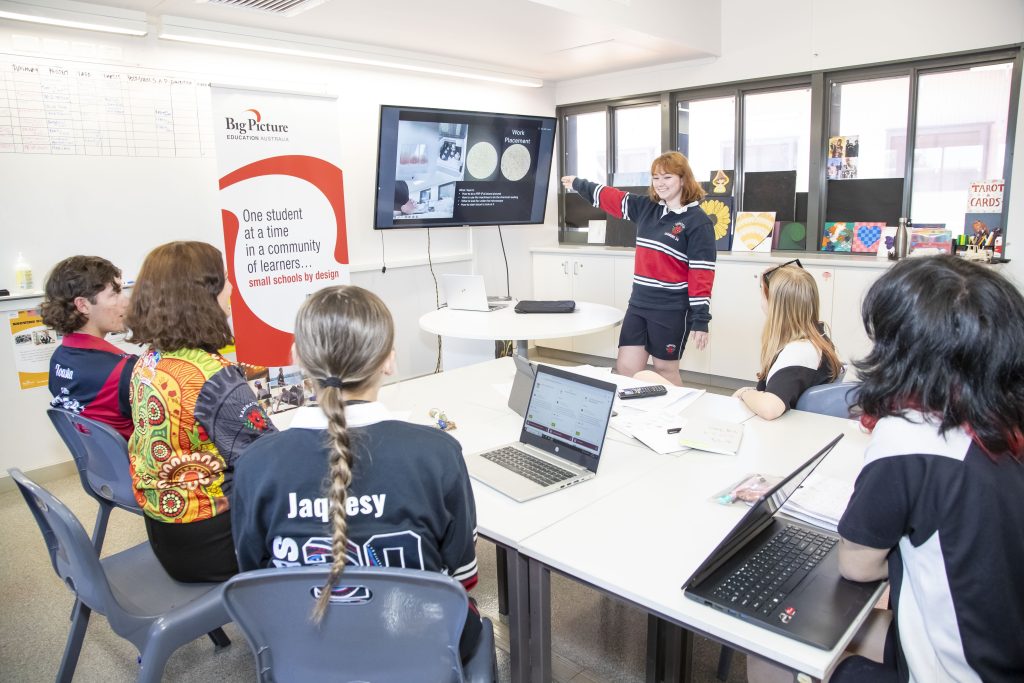
Available to students in Years 9–12, the Big Picture Academy is built around the philosophy of “one student at a time in a community of learners.” Students work in small advisory classes, allowing teachers to understand their strengths, interests, aspirations and individual learning needs.
Big Picture can be particularly well suited to capable students who want greater ownership of their education, including:
- academically motivated students seeking a challenging alternative to an ATAR program;
- students whose strengths are not always captured through traditional tests and examinations;
- students who experience anxiety or other wellbeing challenges in larger, highly structured classroom environments;
- students from EAL/D backgrounds who benefit from strong relationships, personalised support and varied ways to demonstrate their understanding; and
- students who learn best by investigating meaningful questions, completing substantial projects and connecting their learning to the real world.
Big Picture is not an easier option or a reduced academic program. Students are expected to become increasingly independent, manage long-term projects, conduct research, communicate their ideas, respond to feedback and produce work of a high standard.
How does the Big Picture design work?
Each student develops an individual Learning Plan in consultation with their advisory teacher and family. Their learning begins with their interests, strengths and future goals, but expands into rigorous academic work across communication, quantitative reasoning, empirical reasoning, social reasoning, personal qualities and knowing how to learn.
Students move through the Big Picture Action Learning Cycle by:
- identifying an interest, question or area for growth;
- developing a Learning Plan with clear academic and personal goals;
- Connecting with experts, mentors, or community organisations;
- Going on authentic excursions/ incursions to workplaces/ community organisations (leaving to learn)
- Researching, designing and completing authentic projects;
- Presenting their work at a formal Exhibition each term; and
- Reflecting on their progress and setting new goals.
Where appropriate, students also participate in Learning Through Internship, working with a mentor in an area connected to their interests or career aspirations. These experiences help students apply academic learning in authentic settings, develop professional networks and make informed decisions about their future.
Families are an important part of the learning team and are required to participate in Learning Plan meetings, Exhibitions and pathway planning.
Small classes and strong relationships
Each Big Picture class is intentionally kept small, with no more than 16 students in each year group. Students generally remain with the same advisory teacher over several years, helping to create consistency, trust and a strong sense of belonging.
The smaller setting allows students to receive regular feedback and individual guidance while still being expected to take responsibility for their own learning. It can provide a supportive environment for students who are capable of achieving highly but may feel overwhelmed, disengaged or overlooked in a larger mainstream setting.
Years 11 and 12: The International Big Picture Learning Credential
Students in Years 11 and 12 work towards the International Big Picture Learning Credential (IBPLC). The IBPLC is a rigorous, recognised non-ATAR pathway to university, further training and employment.
Rather than reducing a student’s achievements to a single examination score, the credential evaluates their development across six areas:
- knowing how to learn;
- quantitative reasoning;
- empirical reasoning;
- social reasoning;
- communication; and
- personal qualities.
Each student’s results are presented through a personalised Learner Profile and supported by evidence contained in an interactive digital portfolio. This allows universities, training providers and employers to see not only what the student knows, but how they think, communicate, solve problems and apply their learning.
The IBPLC is currently accepted as an entry pathway by 17 Australian universities. This includes Murdoch University, which recognises the credential as one way of meeting entry requirements for many undergraduate courses. Course-specific prerequisites and English-language requirements may still apply.
We are proud to offer an innovative pathway that recognises a broader range of student strengths while maintaining high expectations for academic quality, independence and personal growth. Our goal is for every Big Picture student to graduate with a meaningful credential, a strong portfolio of work and a clear plan for their future.
Applying for Big Picture
Students may apply to join the Big Picture Academy at any time during the year by completing the application form below or collecting a printed copy from the school office.
Applicants participate in a one-week trial at the beginning of a school term before a place in the Academy is offered. The trial allows the student, family and school to determine whether the Big Picture learning design is the right fit.
Current Year 8 students may apply to participate in a two-week trial at the start of Term 4 ahead of possible commencement in Year 9 the following year.
Places are limited due to the intentionally small class sizes, and applications are considered carefully based on each student’s interests, readiness to participate and capacity to engage with the expectations of the program.
For further information about the International Big Picture Learning Credential, please follow the link below: https://www.bigpicture.org.au/what-international-big-picture-learning-credential
For more information visit the Big Picture website.
Contact:
Program Coordinator
Mr Simon Mulvaney simon.mulvaney@education.wa.edu.au
T: (08) 9182 6900